
Shipments will begin on Wednesday, October 28.
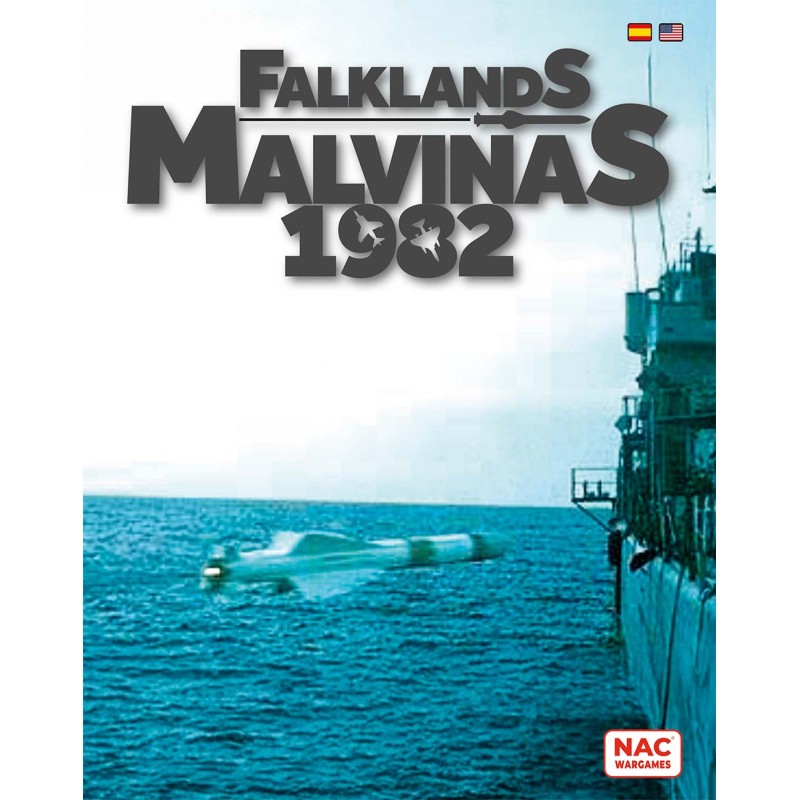
Malvinas 1982 - Falklands 1982 is a historical simulation game for two players that places you at the center of one of the most intense and technologically complex conflicts of the 20th century: the 1982 war over the Falkland Islands (Islas Malvinas) between the Argentine Republic and the United Kingdom.
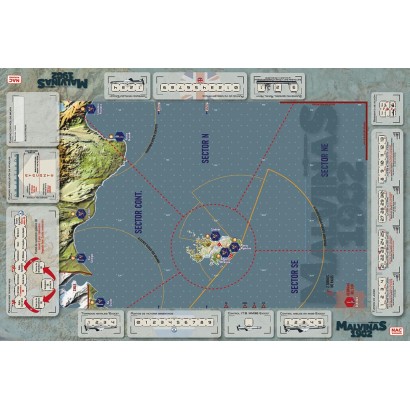
The skies and seas are your battlefield. Relive the air and naval campaign on an operational hex map at a scale of 50 km per hex, where detection, reconnaissance, and the choice of forces and weapons are critical to every operation.
Malvinas 1982 - Falklands 1982 is a historical simulation game for two players that places you at the center of one of the most intense and technologically complex conflicts of the 20th century: the 1982 war over the Falkland Islands (Islas Malvinas) between the Argentine Republic and the United Kingdom.
This is not a game about static trenches or fixed front lines. Here, the skies and seas are the battlefield.
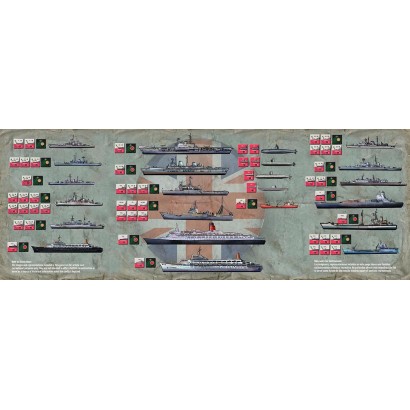
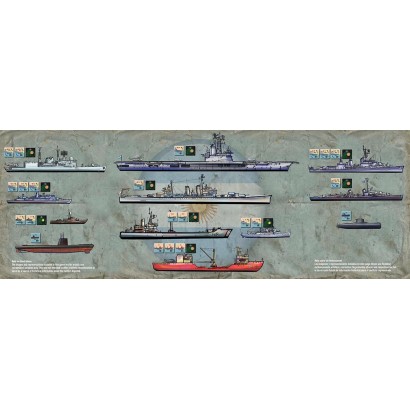
On an operational hex map at a scale of 50 km per hex, players will relive the air and naval campaign with unprecedented technical realism. All major naval units are represented individually for a more immersive command experience: frigates, destroyers, nuclear submarines, Super Étendard squadrons, Harriers, Canberra bombers, reconnaissance aircraft, radar systems, Exocet missiles, torpedoes, escort fighters, and helicopters are deployed in all-out warfare across a vast emptiness, in a hostile and changing environment where detection is everything.
In Falklands 1982, you do more than simply launch attacks: you must identify targets, determine which types of units to use, select their weapons, and decide when to employ them. Decisions matter. Every type of threat, from an aircraft squadron to a hidden submarine, can be countered if you choose your cards... and your weapons wisely.
Detection is the heart of the game. Without knowing where the enemy is hiding, you cannot attack, much less defend yourself. That is why the search and reconnaissance phase is just as critical as combat itself. Electronic surveillance patrols, risky overflights... every move can expose you or reveal the enemy. And sometimes, a single radar switched on can seal your fate.
All types of combat are represented: air-to-air, air-to-surface, surface-to-surface, anti-submarine warfare, long-range bombing, coordinated attacks, convoy defense, suppression of air defenses, electronic warfare, and the insertion of ground forces... The game even includes the historical possibility of a British landing on the islands, provided the British can create a sufficiently secure operational window.
Although Great Britain won historically, the game does not consign the Argentine player to a passive role. Quite the opposite: the Argentine player has numerous strategic tools to disrupt the British advance, harass British forces, inflict devastating damage, and win on points at several possible levels of victory.
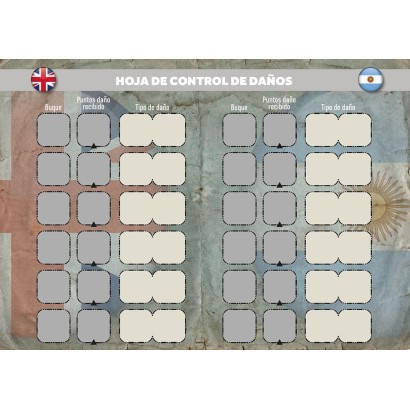
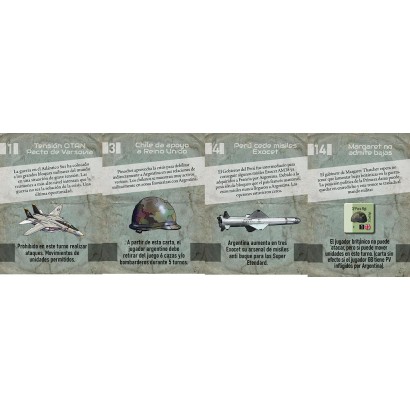
Victory conditions vary according to the length of the campaign, the damage sustained, control of the airspace, the condition of the enemy fleet, or the ability to carry out key operations. This makes every game different, ensures that every decision counts, and maintains the tension until the final turn. You can also play random event cards that add historical flavor and realism, but beware: they may bring a surprise or two.
Dice are used, but their role is limited: chance comes into play only in the final resolution phase. The design emphasizes decision-making, risk management, and operational planning. Every threat has its countermeasure. The key is to choose wisely who acts, when, where, and how.
Falklands 1982 is a tribute to all the combatants on both sides, as well as a game and an educational tool for understanding a brief but pivotal conflict in the geopolitics of the South Atlantic.
The game offers several ways to play, depending on your experience level. Engagement scenarios are designed to help you learn the mechanics and build your experience with the game. Historical scenarios let you replay some of the conflict's most important actions, including the attack on the Sheffield, the torpedoing of the cruiser General Belgrano, and the bombardments of Puerto Argentino. Finally, you can play the full campaign, planning across all its turns to achieve your victory objectives.
But that is not all. With the individually represented naval units included in the game, you can recreate any other operation you like. How about a battle in which both sides launch carrier strikes against each other, recalling the naval engagements of World War II, but with Cold War technology?
Are you ready to command aircraft squadrons, naval task forces, and silent submarines in one of the most extreme environments on the planet?
The war for the Falklands awaits you.
And it does not forgive mistakes.
Data sheet
Shipments will begin on Wednesday, October 28.
Malvinas 1982 - Falklands 1982 is a historical simulation game for two players that places you at the center of one of the most intense and technologically complex conflicts of the 20th century: the 1982 war over the Falkland Islands (Islas Malvinas) between the Argentine Republic and the United Kingdom.
The skies and seas are your battlefield. Relive the air and naval campaign on an operational hex map at a scale of 50 km per hex, where detection, reconnaissance, and the choice of forces and weapons are critical to every operation.