
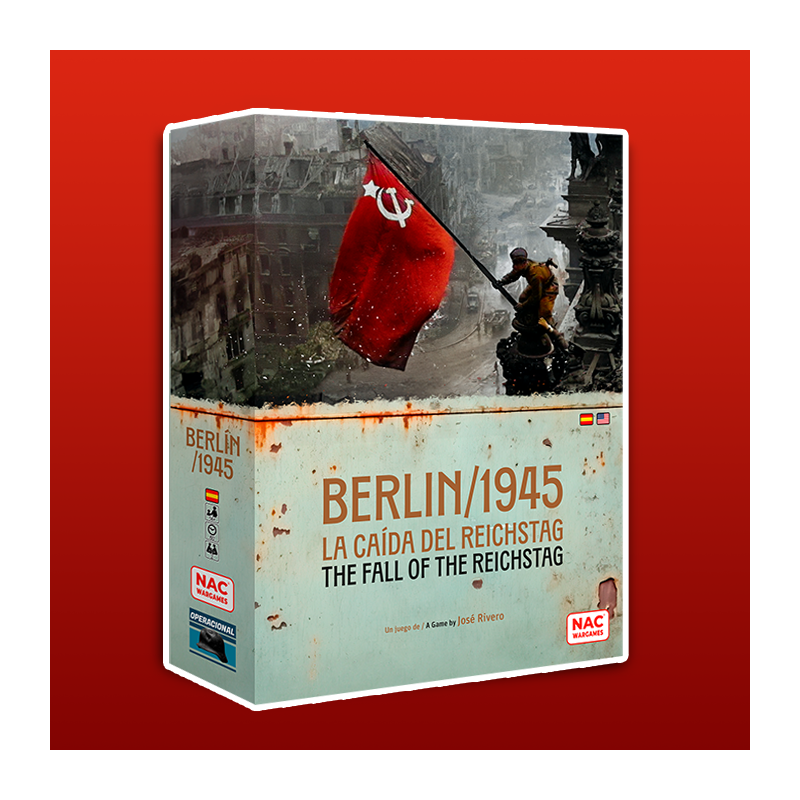
Berlin 1945: The Fall of the Reichstag
Berlin 1945 is a two-player wargame that simulates the Battle of Berlin from April 24 to May 2, 1945—the final major battle and the end of World War II. One player controls the German army, while the other commands the Soviet forces.
Berlín 1945: La caída del Reichstag
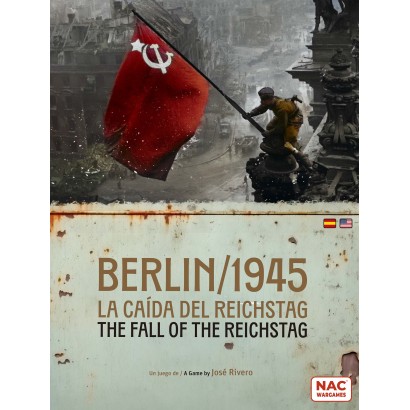
Berlin 1945: The Fall of the Reichstag is a two-player war simulation game that recreates the fighting in the German capital between April 21 and May 2, 1945.
One player commands the Red Army as it advances toward the heart of Berlin, while the other controls the German forces attempting to contain it and prevent the fall of the Reichstag. The two sides face entirely different challenges: the Soviets possess overwhelming material superiority, but must fight their way through a city turned into a fortress before time runs out; the increasingly weakened Germans, with ever fewer opportunities to react, must decide where to stand, which positions to abandon, and how to use their scarce resources to delay the enemy advance.
The game combines area movement, hidden order programming, card management, and a combat system based primarily on comparing strengths. The result is a tense, asymmetric, and accessible wargame capable of condensing the Battle of Berlin into games lasting approximately one hour.
By April 1945, Nazi Germany's defeat was inevitable. The Western Allies were advancing from the west, while the Red Army had crossed Poland and was preparing to launch its final offensive against Berlin.
The Berlin Strategic Offensive Operation began on April 16. Thousands of Soviet artillery pieces, mortars, and tanks opened fire against the last German defensive positions outside the capital. After overcoming fierce resistance at the Seelow Heights, Soviet forces surged toward Berlin.
Three major formations took part in the operation. Marshal Georgy Zhukov's 1st Belorussian Front advanced directly from the east; Ivan Konev's 1st Ukrainian Front approached from the south; and Konstantin Rokossovsky's 2nd Belorussian Front pressed from the north, preventing the German forces deployed there from reinforcing the capital. Zhukov and Konev were also competing for the prestige of being the first to capture the political center of the Third Reich.
On April 21, the first Soviet shells began falling on central Berlin. As the Red Army entered the outer districts, the German authorities organized a desperate defense. General Helmuth Weidling divided the city into defensive sectors and assembled every available force: regular Wehrmacht units, remnants of armored divisions, Waffen-SS contingents, Volkssturm militia, Hitler Youth members, and various foreign formations.
Urban warfare partially offset the Soviets' overwhelming superiority. The broad avenues were exposed to fire from the Flak towers, while canals, fortified stations, demolished bridges, barricades, and mountains of rubble obstructed the tanks. Soviet forces gradually had to move away from large mechanized operations and organize small assault groups capable of clearing buildings, streets, and fortified positions.
By April 24, Berlin was virtually encircled. The following day, Soviet and American troops met on the Elbe, cutting Germany in two. Inside the capital, however, the fighting continued with mounting intensity. Soviet artillery, air strikes, and rocket launchers reduced entire neighborhoods to ruins, but those same ruins created new defensive positions and made the advance even more difficult.
During the final days of April, the ring tightened around the government district. German hopes of receiving help from Steiner's or Wenck's armies proved illusory. The Red Army crossed the Landwehr Canal and the Spree, fought for the Moltke Bridge, and closed in on the Reichstag, the Reich Chancellery, and the bunker where Adolf Hitler and the regime's remaining leaders were gathered.
Hitler committed suicide on April 30. Fighting for the Reichstag, the Chancellery, and the last pockets of resistance continued during the hours that followed. Finally, on May 2, General Weidling surrendered and ordered all resistance in Berlin to cease.
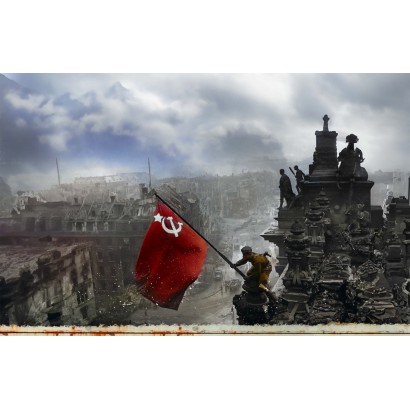
Berlin 1945: The Fall of the Reichstag focuses specifically on those final twelve days. It does not portray the entire campaign beginning on the Oder or the battle for the Seelow Heights, but rather the fighting within Berlin itself: the Red Army's concentric advance, the gradual collapse of the German defenses, and the struggle to reach the political heart of the Third Reich.
The game lasts for a maximum of 12 turns, representing the days from April 21 to May 2, 1945.
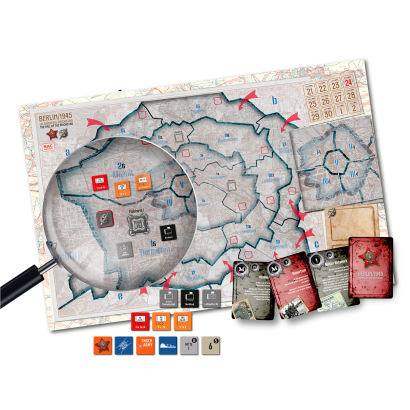
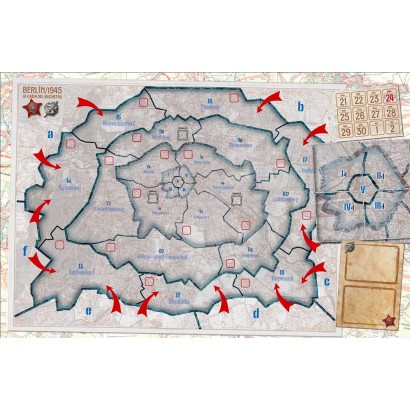
The board divides Berlin into a series of concentric rings:
The Soviet player must penetrate the city, break through its successive defensive rings, and concentrate sufficient combat strength at the Reichstag to win. At the end of the final turn, Soviet combat strength in Sector V must be at least twice the German combat strength present there.
The German player wins by preventing the Soviet player from fulfilling that condition. In addition, from the end of Turn 4 onward, the Germans achieve an automatic victory if their total combat strength in Berlin ever exceeds the total Soviet combat strength.
This second condition prevents the Soviet player from simply forcing a single corridor toward the Reichstag while ignoring losses elsewhere. The Soviets must advance quickly, but must also preserve enough forces on the board to keep the offensive from collapsing.
There are no draws: by the end of the game, one of the two sides will have achieved its objective.
The map does not represent Berlin with a hex grid, but as a network of connected areas. The city's districts form several rings around Mitte, making it immediately clear whether a unit is advancing toward the Reichstag, moving laterally, or falling back.
This structure turns the board into a very readable maneuver space while still presenting numerous tactical decisions. Players must identify routes of penetration, block connections, reinforce threatened districts, and control access to the central sectors.
Stacking limits vary by district. Some areas allow large formations to be concentrated, while others restrict the number of units that can fight there. Soviet numerical superiority therefore cannot be applied equally at every point on the front: forces must be distributed, routes cleared, and the main effort carefully chosen.
Each turn is divided into five phases:
The sequence is easy to understand, but the order in which the players act creates constant uncertainty.
The Soviet player begins by secretly planning movement. Using an order sheet concealed behind a screen, the Soviet player records which formations will move, where they will start, how many units will take part, and where they will go.
The German player then carries out their own movements directly on the board, without knowing the Soviet orders. The Germans may reinforce a district, abandon a position, launch a counterattack, or move troops toward a sector they believe to be threatened.
Only then are the Soviet orders revealed. The Soviet player must carry them out exactly as programmed, provided the German movements have not made them illegal or impossible. A German formation entering the right district may block an offensive, force units to remain behind to cover a retreat, or even cancel a Soviet order entirely.
This system recreates command friction and uncertainty without resorting to excessive complexity. For the Soviets, each turn is an exercise in anticipating the German reaction; for the Germans, it is a matter of interpreting the enemy deployment and trying to determine where the next blow will fall.
Neither player can freely move every unit. Each side has a limited number of orders and must decide which sectors demand immediate attention.
One order allows a formation located in the same area to move. That formation may advance toward a single destination or split and move toward two adjacent areas, while also leaving units behind if the player considers it necessary.
There are four main types of movement:
The Retreat and Withdrawal rules are particularly important for the German player. The Germans cannot simply concentrate every unit at the Reichstag on the first turn and wait for the Soviets to arrive. These restrictions force them to defend the city, contest its districts, and conduct a gradual fighting withdrawal.
The asymmetry extends far beyond the number of units. Each player manages orders in a different way.
The Soviet player normally receives three basic orders per turn. This number remains unchanged throughout the game, although certain cards or discarded cards may provide additional actions.
The German player begins with four basic orders, but their command capacity deteriorates as the enemy penetrates Berlin:
These reductions are permanent, even if the German player later recaptures the lost areas. Pressure is represented not only through territorial and unit losses, but also through the gradual collapse of the German command structure.
An area is controlled by one side when it contains only that player's units. Control is retained even if the district becomes empty and changes only when the opposing side takes possession of it.
When units from both sides occupy the same area, it becomes disputed and combat must be fought during the corresponding phase. Survivors from both armies may remain there after the battle, meaning that a district can remain contested over several turns.
Territorial control is essential for rebuilding units, keeping movement routes open, and preparing the final assault on Mitte.
Combat is resolved by comparing the total strength of the opposing units, modified by any relevant cards and markers.
Regular units have a combat strength of 1, while Soviet elite formations and SS units have a combat strength of 2. The side with the higher total wins the battle, and losses depend on the ratio achieved:
The die does not decide who wins the battle. It is used only to determine whether the victor also suffers attrition after inflicting two or three losses, as well as for certain special effects such as barricades. Players can therefore calculate the likely consequences of an attack without ever being completely certain that the winner will emerge unscathed.
When several combats occur during the same turn, the German player decides the order in which they are resolved. This decision can prove critical, as cards used or drawn after one engagement may affect those that follow.
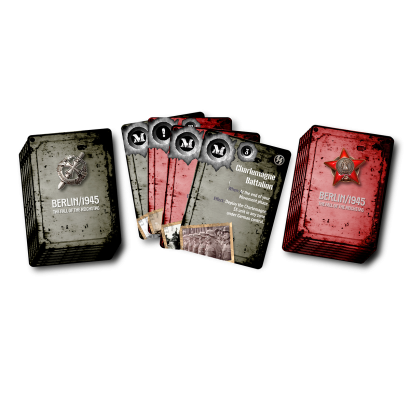
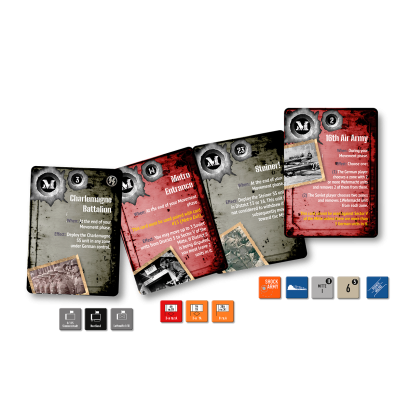
Each side has its own deck of 25 cards. Players begin with five cards in hand, draw one new card each turn, and may never hold more than six.
The cards represent historical figures, units, weapons, events, and circumstances from the battle. They include Zhukov, Konev, Chuikov, Weidling, Kampfgruppe Mohnke, the Flak towers, barricades, Panzerfausts, Katyusha rocket launchers, the Moltke Bridge, the Berlin U-Bahn network, air strikes, ammunition shortages, and disruption within the command structure.
Depending on their type, cards can:
Cards also function as resources. A player may discard cards to obtain an additional order or rebuild an eliminated unit. This creates a constant decision: preserve a card for its special ability or sacrifice it to address an immediate need on the board.
Every card that is played or discarded is permanently removed from the game. Furthermore, because not every card will be drawn during the twelve turns, neither player can be certain which events will occur or which resources remain in the opponent's hand.
The Soviet player receives a single predetermined wave of reinforcements during Turn 4: eight units that must be divided between two entry areas on opposite sides of Berlin.
The German player receives no automatic reinforcements. New German units enter play through specific cards, such as Wenck's 12th Army, the Charlemagne Battalion, the Volkssturm, or Steiner's group. Their arrival therefore depends on hand management and on which cards are drawn.
Both players may rebuild certain previously eliminated regular units by discarding cards and placing them in an area under their control. Elite formations cannot be rebuilt through a normal order, making each such loss particularly significant.
The central strength of Berlin 1945 is that the two players do not experience the same battle.
The Soviet player has more troops and maintains a stable command capacity, but is fighting both the defender and the clock. The Soviets must open several approaches, prevent dangerous German concentrations, manage stacking limits, and decide when to commit their elite formations. Advance too slowly and they will fail to reach the Reichstag; rush forward and suffer too many losses, and they may hand the Germans an automatic victory.
The German player initially enjoys greater operational flexibility and moves after the Soviet orders have already been programmed. However, the Germans do not know what those orders are, and their ability to react declines irreversibly. Every Soviet penetration reduces the number of sectors they can address. Holding a position for one more turn may prove decisive, but it may also cost units that will be needed for the final defense.
The cards multiply these decisions. Their use goes well beyond adding modifiers: some conceal intentions, cancel orders, alter routes, accelerate movement, or restore units. Because cards spent to obtain additional actions are permanently lost, every immediate advantage carries a potential long-term cost.
Replayability comes from the interaction of several elements:
The result is a battle that remains historically recognizable without following a predetermined course. The Red Army will always advance toward the center and the Germans will always try to contain it, but the front line, concentrations of force, and decisive events will change from one game to the next.
Berlin 1945 condenses a complex urban campaign into a streamlined rules system. The limited number of orders and the clarity of the map reduce administrative overhead, while ensuring that every action has strategic consequences.
There is no need to control hundreds of units or consult numerous tables. The game's depth comes from anticipation, positioning, hand management, and the constant need to choose among competing priorities.
Area movement makes the board easy to read and allows players to understand the general direction of each operation at a glance. Units use straightforward combat values, and engagements are resolved through direct comparison.
These features make the game an excellent introduction to historical conflict simulations, while hidden order programming, the order economy, and tactical card play provide enough depth to satisfy experienced players.
The forces committed to an engagement determine the winner. Randomness is reserved for possible attrition suffered by the victor and for certain specific events.
Players can calculate outcomes, evaluate risks, and prepare attacks with a clear understanding of their basic consequences. Hidden orders and cards, however, prevent the game from becoming completely predictable.
The historical elements are more than unit names or decorative illustrations. Flak towers hinder Soviet air attacks, barricades slow the advance, the demolition of the Moltke Bridge restricts access to the Reichstag, the U-Bahn network enables unexpected movement, and figures such as Zhukov and Konev increase Soviet operational capacity.
The cards introduce history without burdening the rulebook with permanent exceptions. Each event appears when relevant and temporarily changes the situation on the board.
The Soviet player feels the urgency to advance, while the German player experiences the pressure of being unable to defend everything. The progressive reduction of German orders offers a simple and highly effective representation of the breakdown in communications, resources, and command capacity.
This is not simply a contest between a large army and a small one: each side has its own tools, limitations, and victory conditions.
The board is based on a German map of Berlin found in Hitler's bunker, on which the approaching movements of Soviet forces had been marked. The counters use tactical symbols inspired by those employed by the two armies in 1945 rather than relying exclusively on NATO symbology.
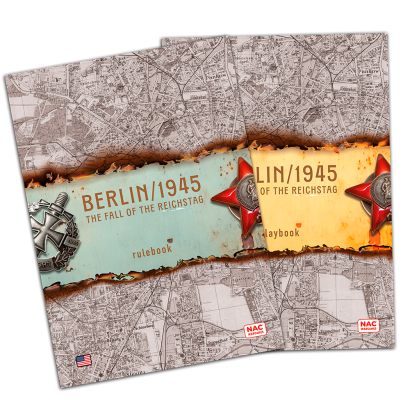
The rulebook is accompanied by a playbook containing the initial setup, detailed examples, an individual explanation of all 50 cards, designer's notes, and an extensive historical introduction to the battle.
Berlin 1945: The Fall of the Reichstag will appeal to you if you are looking for:
Soviet victory requires maintaining the momentum of the offensive until the final turn. German victory requires turning every district and every day gained into one more obstacle for the attacker. Whichever side you choose, the tension remains until the final assault on the Reichstag.
Download English Rulebook and Playbook here
Data sheet
Berlin 1945: The Fall of the Reichstag
Berlin 1945 is a two-player wargame that simulates the Battle of Berlin from April 24 to May 2, 1945—the final major battle and the end of World War II. One player controls the German army, while the other commands the Soviet forces.