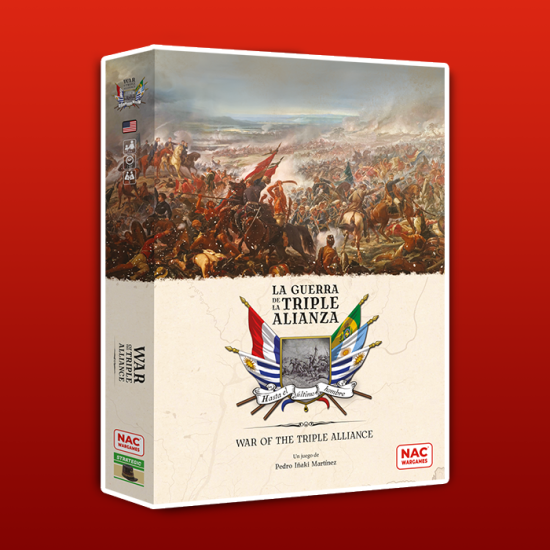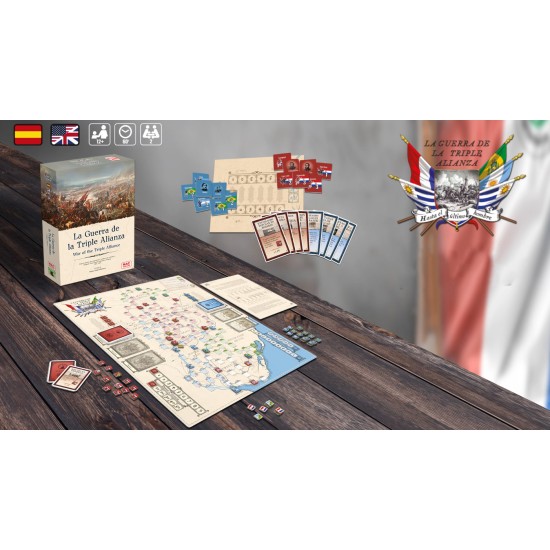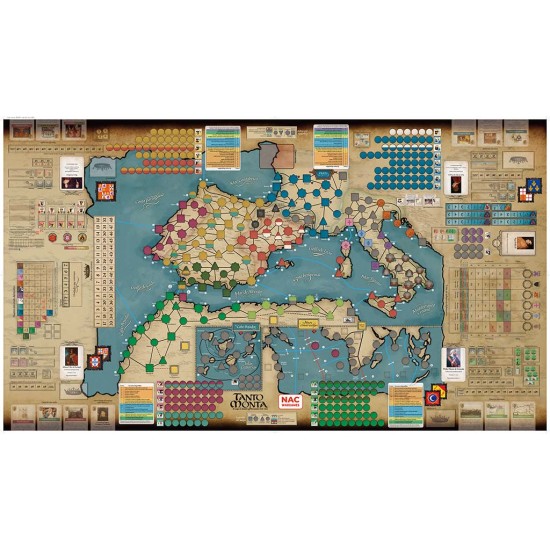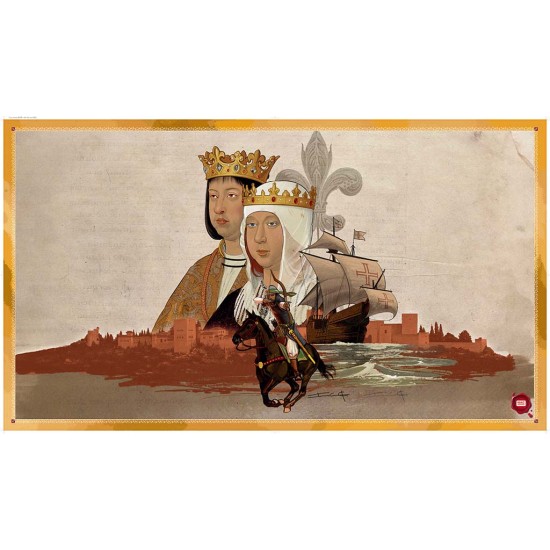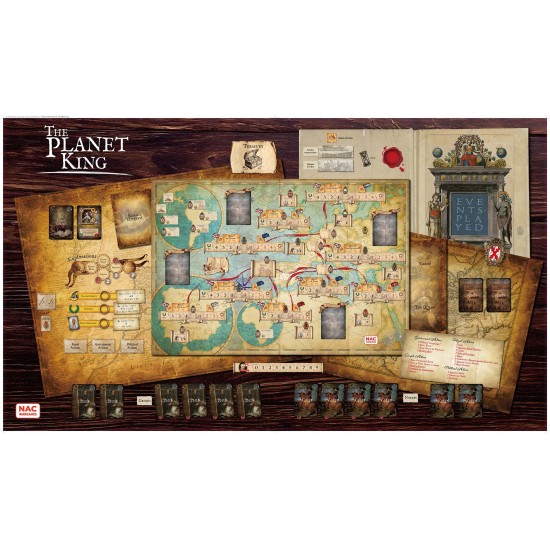
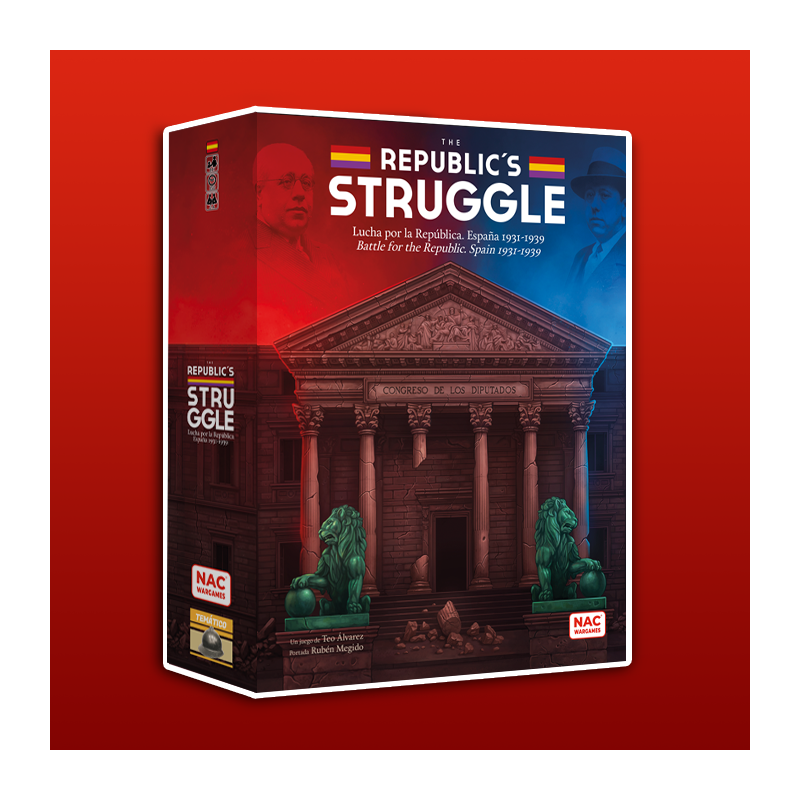
Spain, 1931–1939. One Republic, two irreconcilable visions of the country, and a struggle that will move from parliament and the streets to the battlefields of the Spanish Civil War.
Republic Struggle draws inspiration from the mechanics of Twilight Struggle, but far from being a mere copy, it represents a refined evolution with a unique identity. Its design introduces new options and elements, carefully tailored to the historical events it seeks to recreate.
Spain, 1931–1939. One Republic, two irreconcilable visions of the country, and a struggle that will move from parliament and the streets to the battlefields of the Spanish Civil War.
Republic Struggle draws inspiration from the mechanics of Twilight Struggle, but far from being a mere copy, it represents a refined evolution with a unique identity. Its design introduces new options and elements, carefully tailored to the historical events it seeks to recreate.
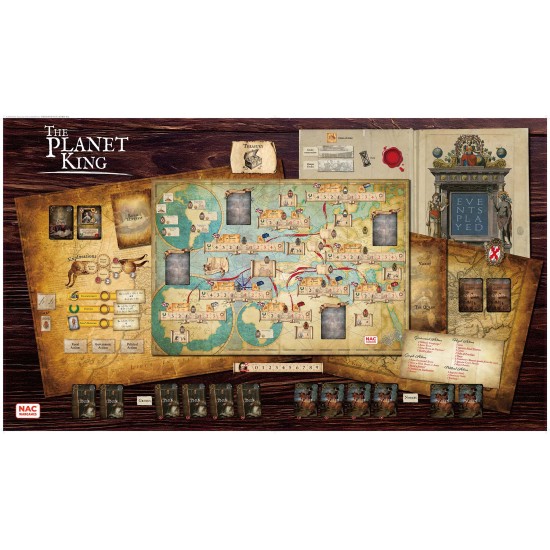
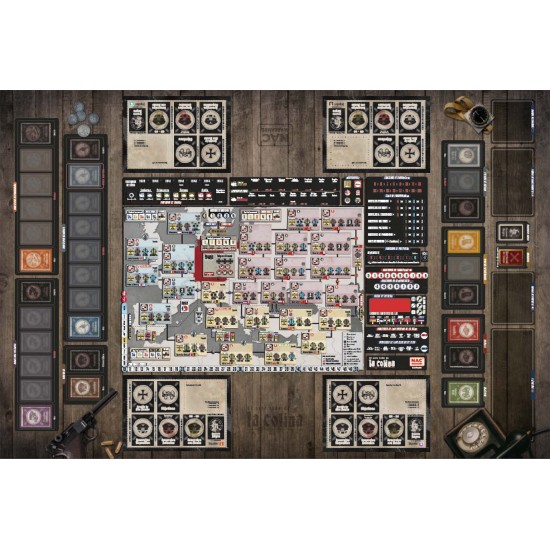
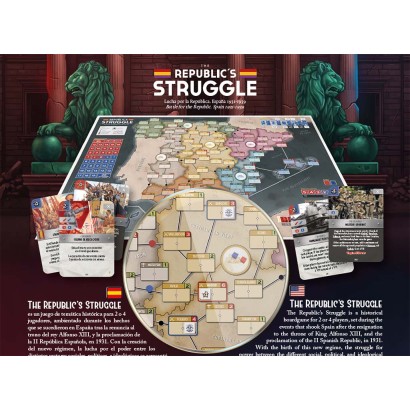
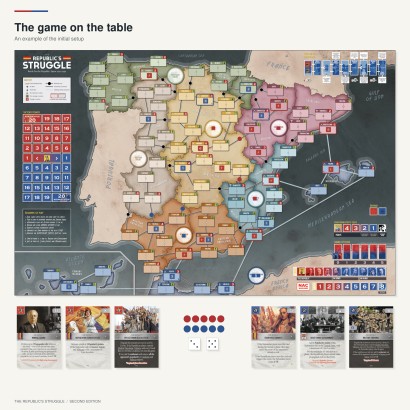
The Republic’s Struggle is a historical card-driven strategy game for two players, with an additional four-player team mode, in which the Republican and Nationalist sides compete for political, social, diplomatic, and military control of Spain. The game covers the entire period from the proclamation of the Second Spanish Republic in 1931 to the end of the Civil War in 1939, combining electoral competition, propaganda, popular mobilization, international pressure, uprisings, blockades, and conventional warfare in a single interconnected system.
Every card creates a difficult choice. It can be used for its historical event or for Operations Points, forcing players to decide between immediate tactical needs and the long-term consequences of allowing history to unfold. Political control, military strength, diplomatic influence, and the European balance are constantly linked, producing a tense and highly thematic game in which no decision is isolated.
The Republic's Struggle - English Trailer
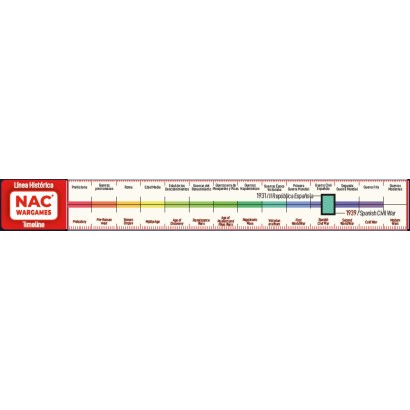
On April 14, 1931, the Second Spanish Republic was proclaimed following municipal elections that revealed broad support for republican candidates in the country’s major cities. The new regime embarked on an ambitious program of political, social, military, educational, and territorial reform. These changes generated hope among large sectors of the population, but also fierce opposition from groups that felt threatened by the transformation of the traditional order.
During the following years, Spanish politics became increasingly polarized. Governments of different tendencies attempted to implement or reverse reforms while strikes, revolutionary movements, political violence, military conspiracies, and confrontations between rival organizations deepened the crisis. The electoral victories of the left and the right altered the balance of power, but neither side succeeded in creating a stable national consensus.
In July 1936, a military uprising against the Republican government failed to seize the entire country and instead triggered a prolonged civil war. Spain was divided into two zones, and the conflict rapidly acquired an international dimension. Germany and Italy supported the Nationalist side, while the Soviet Union and the International Brigades assisted the Republic; the Western democracies largely maintained a policy of non-intervention. What began as a coup became a brutal three-year war marked by major offensives, sieges, political repression, foreign intervention, and deep internal divisions.
The Republic’s Struggle recreates this full historical arc. The game does not begin with armies already deployed for war: it starts with the political struggle of 1931, allowing both players to shape the balance of power that will determine the conditions under which the military conflict may later be fought.
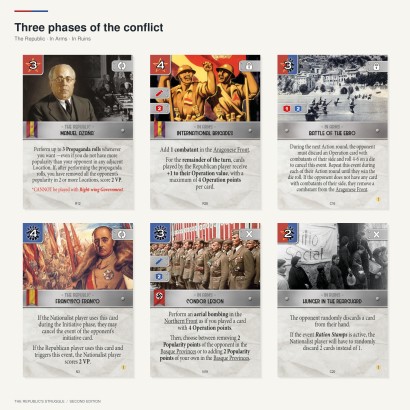
One player controls the Republican side and the other the Nationalist side. Over ten turns, divided into three historical phases—The Republic, In Arms, and In Ruins—both players compete to gain Popularity, control key locations and regions, influence diplomacy, deploy forces, and fulfill the conditions shown on the scoring cards.
The first four turns represent the political struggle during the Second Republic. The final six turns cover the military uprising and the Spanish Civil War. The actions taken during the political phase influence the strategic position with which each side enters the armed conflict, so success before the war can prove decisive once military operations begin.
Victory Points are gained and lost through political control, regional dominance, military achievements, historical events, and periodic scoring. The position of the Victory Point marker reflects the changing advantage between both sides, while certain circumstances can also produce an immediate victory before the tenth turn.
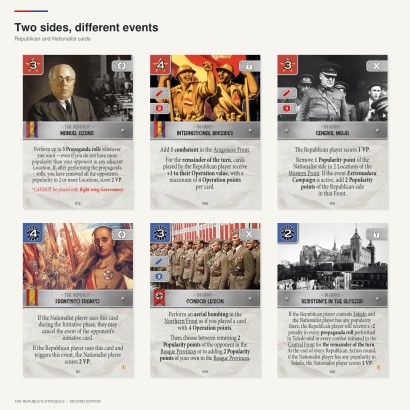
A card-driven game with genuine dilemmas. The heart of the game is its multi-use card system. Cards can normally be played for their event or for Operations Points. Using a powerful historical event may alter the political or military situation dramatically, while spending the card for operations provides the flexibility needed to act on the board. Choosing when to sacrifice one possibility for the other is one of the game’s central challenges.
Initiative and Defense. At the beginning of each turn, both players secretly select an Operations card and reveal it simultaneously. The card with the higher Operations value wins the initiative, while its value also establishes that side’s Defense for the entire turn. This creates a meaningful opening decision: committing a strong card may secure the tempo and improve protection, but it also removes that valuable card from the player’s hand.
Seven action rounds per turn. Players alternate actions over seven rounds, with diplomacy potentially granting an additional eighth round. This structure creates a continuous contest for timing. Acting early may secure a vulnerable position, but holding the right response until later can be equally important.
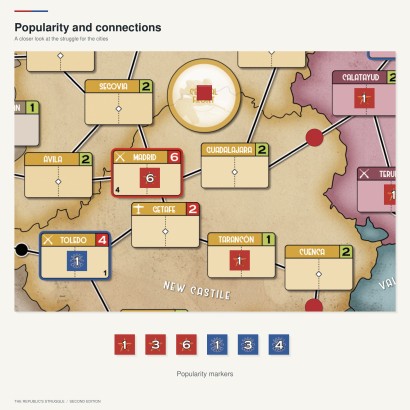
Popularity and political control. Players place, remove, and modify Popularity markers across the map. These markers represent political support and are essential for controlling locations, regions, and objectives. Popularity is not merely an abstract resource: its distribution determines where each side is strong, where propaganda can be effective, and which areas may score.
Propaganda operations. Operations Points can be used to expand a side’s support or undermine the opponent’s influence. Because neighboring positions and existing control can affect how influence spreads, the political contest develops geographically rather than as a simple numerical track.
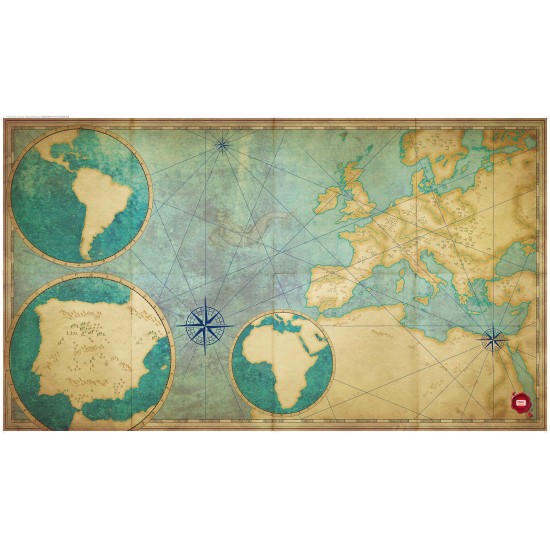
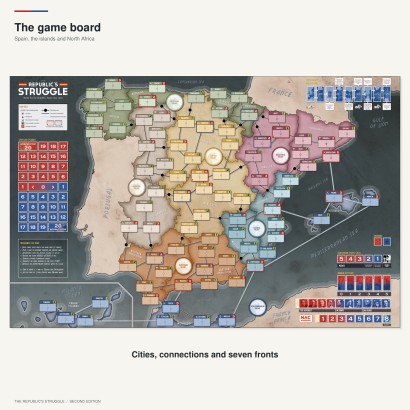
Regions, Battlefronts, and key locations. Spain is divided into interconnected areas whose political and strategic importance varies. Players must decide whether to concentrate on decisive regions, contest enemy strongholds, protect communication routes, or spread their influence widely enough to threaten several scoring opportunities at once.
Scoring cards. Nine scoring cards evaluate control of specific areas and objectives. Their appearance forces players to reassess priorities and prepare for scoring without neglecting the wider strategic situation. Because cards must also be managed as events and operations, a scoring card can radically affect the rhythm of a hand.
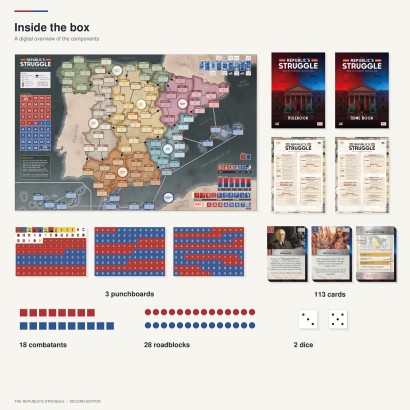
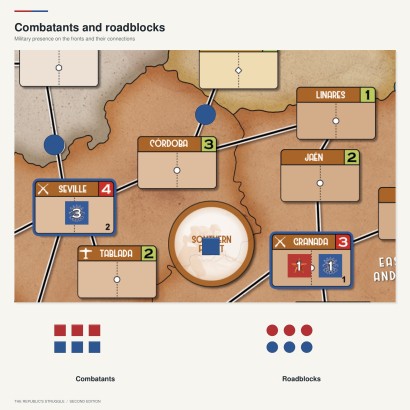
Combatants and Battlefronts. Once the struggle becomes a military conflict, both sides deploy Combatant cubes to the fronts. Military presence, local support, and card effects combine to determine the strength and vulnerability of each position. The Republican and Nationalist sides do not possess identical forces, reinforcing their historical asymmetry.
Roadblocks, isolation, and encirclement. Roadblock discs allow players to interfere with terrestrial communications and create strategically isolated areas. At the end of each phase, encirclement conditions are checked, making supply routes and geographic continuity crucial. A position that appears secure can become untenable if its connections are severed.
Combat resolution. Military clashes are resolved through the interaction of deployed forces, modifiers, card effects, and dice. Combat matters, but it is never detached from the political map: Popularity, control, access, and previous decisions shape the conditions under which the fighting takes place.
Aerial bombing. Air operations can affect the enemy’s position and introduce an additional layer of pressure. Their impact is tied to the broader military and international situation rather than functioning as an isolated subsystem.
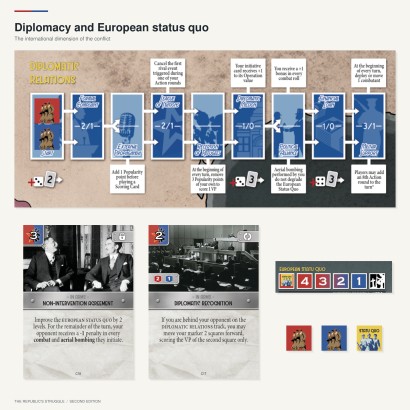
The European Status Quo and Armed Actions. The game tracks the deterioration of the European political environment and the growing willingness of foreign powers to intervene. Events can move the European Status Quo and Armed Actions markers, changing the strategic possibilities available to both sides and reflecting Spain’s place within the escalating continental crisis.
Diplomacy. Players compete for diplomatic advantages that can provide extra opportunities, including the possibility of an additional action round. International influence therefore affects not only individual events but also the tempo of an entire turn.
Chronological historical events. The decks guide the game through the political and military evolution of the period without forcing every match to follow a fixed script. Elections, social unrest, political organizations, foreign assistance, major campaigns, and pivotal personalities enter play in a broadly historical sequence, while player decisions determine their precise impact.
Special transition cards. Key cards such as Military Uprising and Proletarian Revolution mark decisive changes in the conflict and help transform the political confrontation into open war. Their effects connect the two halves of the game and make earlier decisions matter when the strategic landscape changes.
The Republican and Nationalist sides approach the struggle from different political, territorial, and military positions. Their separate decks contain distinct events, opportunities, and problems, so each side requires its own strategic logic. Learning how the opposing deck works is as important as mastering your own.
Replayability comes from the order in which cards appear, the initiative system, different operational uses for every hand, the interaction between political and military control, changing diplomatic conditions, and the players’ strategic priorities. Historical events provide a recognizable framework, but the game allows the conflict to develop differently each time.
An optional faction-scoring module adds another level of internal political tension. Twenty faction markers and a dedicated scoring card represent the competing groups within each coalition, giving experienced players additional objectives and incentives without changing the game’s central structure.
You will enjoy The Republic’s Struggle if you like historical games in which political maneuvering matters as much as battlefield performance. It is especially well suited to players who appreciate card-driven designs, asymmetric factions, high interaction, and difficult decisions with consequences that may not become clear until several turns later.
The game rewards planning without becoming predictable. You must read your opponent, judge when to trigger historical events, protect your strongest regions, manage your hand carefully, and prepare for a war whose initial conditions are created by the political struggle that precedes it.
It is also an excellent choice for players interested in modern Spanish history. Rather than isolating the Civil War from its origins, the design presents the entire 1931–1939 period as a connected process, giving context to the forces, crises, and foreign pressures that shaped the conflict.
For experienced pairs, the optional rules and asymmetric decks provide considerable replay value. For four players, the team game introduces a different kind of challenge: political and military partners must coordinate their objectives while adapting to an opponent whose plans are equally divided between two minds.
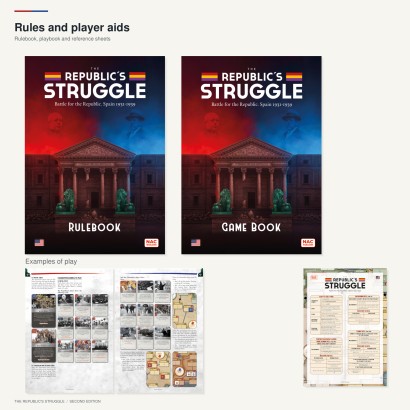
Download The Republic Struggle RuleBook
Data sheet
Spain, 1931–1939. One Republic, two irreconcilable visions of the country, and a struggle that will move from parliament and the streets to the battlefields of the Spanish Civil War.
Republic Struggle draws inspiration from the mechanics of Twilight Struggle, but far from being a mere copy, it represents a refined evolution with a unique identity. Its design introduces new options and elements, carefully tailored to the historical events it seeks to recreate.